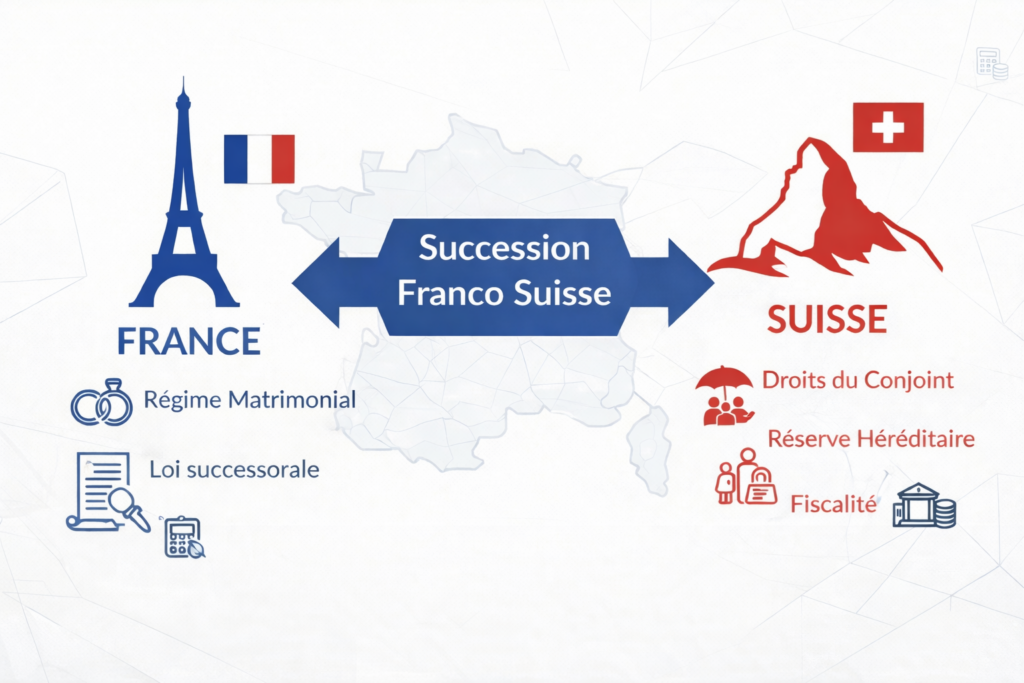
Inheritance cases involving France and Switzerland raise complex issues of private international law, civil law, and wealth taxation. When a couple resides in Switzerland while holding real estate assets and financial assets on both sides of the border, estate settlement requires a structured approach to avoid conflicts of law and the risks of double taxation.
Based on a case study presented during a webinar on Franco-Swiss inheritance, this article offers a professional and operational overview of key points: matrimonial regime, applicable inheritance law, rights of the surviving spouse, forced heirship, and inheritance taxation.
Understanding the Settlement Method: Civil Before Tax
A common mistake is to focus on inheritance taxes while neglecting civil law. However, taxation only becomes relevant after clarifying asset ownership and heirs’ rights. Estate settlement is traditionally analyzed in three stages.
- Determining what the deceased owned at the time of death, which refers to the law applicable to the matrimonial regime and its liquidation.
- Determining who inherits what, which falls under inheritance law and rules relating to shares, spousal rights, and forced heirship.
- Identifying the applicable taxation, by analyzing the competent state, the taxable base, exemptions, and risks of double taxation.
Matrimonial Regime: Marriage Contract or Default Rules
With a Marriage Contract: The Law Chosen by the Spouses
In the presence of a marriage contract, the guiding principle is party autonomy. Spouses can, within certain limits, choose the law applicable to their matrimonial regime. Swiss law is presented as particularly flexible, allowing for the choice of the law of domicile, a future domicile, or national law. On the French side, the approach is also based on the application of the law designated in the contract.
In practice, a marriage contract offers a decisive advantage: it permanently establishes the applicable regime and reduces the risk of differing interpretations between French and Swiss authorities, particularly in the event of death or divorce.
Without a Contract: Risk of Divergence Between Swiss and French Approaches
In the absence of a contract, the rules for determining the applicable law can lead to a different assessment of the same situation depending on whether one takes the Swiss or French perspective.
On the Swiss side, the analysis emphasizes common domicile and may lead to the application of Swiss law to the entire matrimonial regime, with an effect that can be presented as retroactive to the marriage. On the French side, the approach mentioned is based on the first matrimonial domicile after marriage, which may lead to maintaining the original regime, with exceptions.
This divergence is a classic source of conflict of laws and can turn the liquidation of the matrimonial regime into a particularly delicate exercise, especially if several regimes are likely to succeed one another over time.
Why Securing the Matrimonial Regime is Central
When France and Switzerland do not analyze the matrimonial regime according to the same criteria, one can end up with differently reconstituted asset pools: what one considers community property may be treated as separate property or as an asset belonging to another asset pool by the other system. This discrepancy directly impacts the composition of the estate and, by rebound, taxation.
The operational message is clear: for a couple with cross-border assets, signing a marriage contract is often the most effective lever to reduce complexity and improve predictability.
Comparison of Matrimonial Regimes: False Friends Between the Two Systems
The French Legal Regime: Community of Acquests
The French legal regime is that of the community of acquests. It traditionally distinguishes between a common mass, corresponding to wealth accumulated during the marriage, and separate property for each spouse, including assets held at the time of marriage and those received free of charge.
The Swiss Legal Regime: Participation in Acquests
The Swiss legal regime is that of participation in acquests. Despite similar terminology, acquests do not automatically follow the same logic as in French law. The system is presented as close to a separation of property during the marriage, with the distinction and calculations becoming fully operative upon dissolution of the regime, particularly upon death.
This structural difference explains why a couple accustomed to French logic may feel less comfortable with Swiss mechanisms. Here again, the marriage contract allows for adapting the legal framework to wealth objectives.
Applicable Inheritance Law: Last Domicile and Unity of Succession
Guiding Principle: Last Habitual Residence or Last Domicile
The framework presented is based on a converging rule: the law of the last habitual residence or the last domicile of the deceased plays a central role in determining the applicable inheritance law. In the case of a couple settled in Switzerland, Swiss law is therefore, by default, likely to govern the entire inheritance, including French movable and immovable property.
Can Another Inheritance Law Be Chosen?
Wealth planning can allow for a professio juris, i.e., an anticipated choice of the applicable inheritance law in favor of national law.
In practical terms, opting for French law means that French inheritance law would apply to the entire estate, regardless of the nature and location of the assets, subject to mandatory rules that may interact with certain real estate assets.
Surviving Spouse and Forced Heirship: Structuring Differences
Without Arrangement: Distinct Inheritance Philosophies
The rules regarding the rights of the surviving spouse differ significantly between the two systems. Swiss law is presented as granting a determined share to the spouse in the absence of specific provisions, while French law adopts an option logic allowing the spouse to choose between full ownership and usufruct depending on the family configuration.
Forced Heirship: Protection of Heirs and Degrees of Freedom
The forced heirship structures the freedom to dispose of assets. The webinar highlights a framed reserve in Swiss law, with a reserved portion allocated to the spouse and children, while French law is characterized notably by the idea that the spouse is not necessarily a forced heir in the presence of children, and by a children’s reserve described as higher than that observed in Switzerland.
These differences lead to a wealth planning trade-off: if the objective is to maximize full ownership transferred to the spouse, Swiss inheritance law may offer more flexibility in certain configurations, whereas French law may be more suitable in other situations, particularly when the family is blended.
Favoring the Spouse: The Need for a Will
Solutions to benefit the spouse are not automatic. They rely on testamentary anticipation: the testator must provide, through a will, mechanisms giving the spouse the option to choose between different attribution methods. This requirement confirms the importance of coherent planning between the will, matrimonial regime, and inheritance law.
Harmonizing Matrimonial Regime and Inheritance Law: Avoiding Boomerang Effects
A major point of vigilance concerns strategies involving choosing a matrimonial regime highly protective of the spouse while subjecting the inheritance to another law. The frequently cited example is that of universal community property with full attribution to the surviving spouse. Such a combination, if dissociated from inheritance law, can generate difficulties in the presence of forced heirship and mandatory rules.
The principle of prudence highlighted is as follows: align as much as possible the law chosen for the matrimonial regime and the law chosen for the inheritance. This consistency reduces the risk of contestation, family disputes, and liquidation complexities.
Franco-Swiss Inheritance Taxation: End of Conventional Approach and Risks of Double Taxation
Since the Denunciation of the Convention: Application of Domestic Laws
In the tax field, the key lesson is the disappearance of a bilateral framework for inheritance taxes between France and Switzerland, which leads each administration to apply its domestic rules. This situation creates an increased risk of double taxation and necessitates a case-by-case analysis, depending on tax residence, domicile, asset location, and the status of the heirs.
Tax Pressure Gaps: Switzerland and France
The webinar highlights marked differences: in France, spousal exemption is granted, but direct line taxation can reach high levels via a progressive scale. In Switzerland, inheritance taxation depends on the canton, with very favorable situations in the direct line.
Real Estate: Location and Tax Jurisdiction
A practical principle is reiterated: real estate assets located abroad may be subject to taxation in the state of location, even when the deceased is domiciled in Switzerland. The presence of real estate assets in France therefore constitutes a major point of attention in any transmission strategy.
Tax Residence and Inheritance Taxes: A Risk of Cross-Qualification
Finally, it is recalled that a person may be considered a resident of Switzerland for income tax purposes, while potentially being viewed differently by France regarding gift taxes and inheritance taxes, as the applicable income tax convention does not cover these duties. In practice, France may then apply its own internal criteria, which requires a rigorous verification of the family and asset situation.
Best Practices for Cross-Border Wealth Planning
- Map the assets, distinguishing between real estate, securities, bank accounts, participations, and wealth structures, including holding vehicles.
- Secure the matrimonial regime with a contract adapted to the Franco-Swiss context and the couple’s objectives.
- Determine the inheritance law most consistent with family objectives, forced heirship, and spousal protection.
- Draft a structured will compatible with the chosen law, especially if an option in favor of the spouse is envisaged.
- Anticipate taxation with a cross-analysis between France and Switzerland, integrating the location of properties and the residence criteria applicable to transfer duties.
- Seek coherence between the matrimonial regime, inheritance law, and transmission strategy to reduce the risk of conflict of laws.
Conclusion: An Integrated Approach to Securing Transmission
A Franco-Swiss inheritance is not solely addressed from the perspective of tax rates. It is first prepared on the grounds of civil law and private international law, by securing the matrimonial regime, judiciously choosing the applicable inheritance law, and drafting coherent last wills and testaments. Only then can inheritance taxation be managed and the risks of double taxation limited.