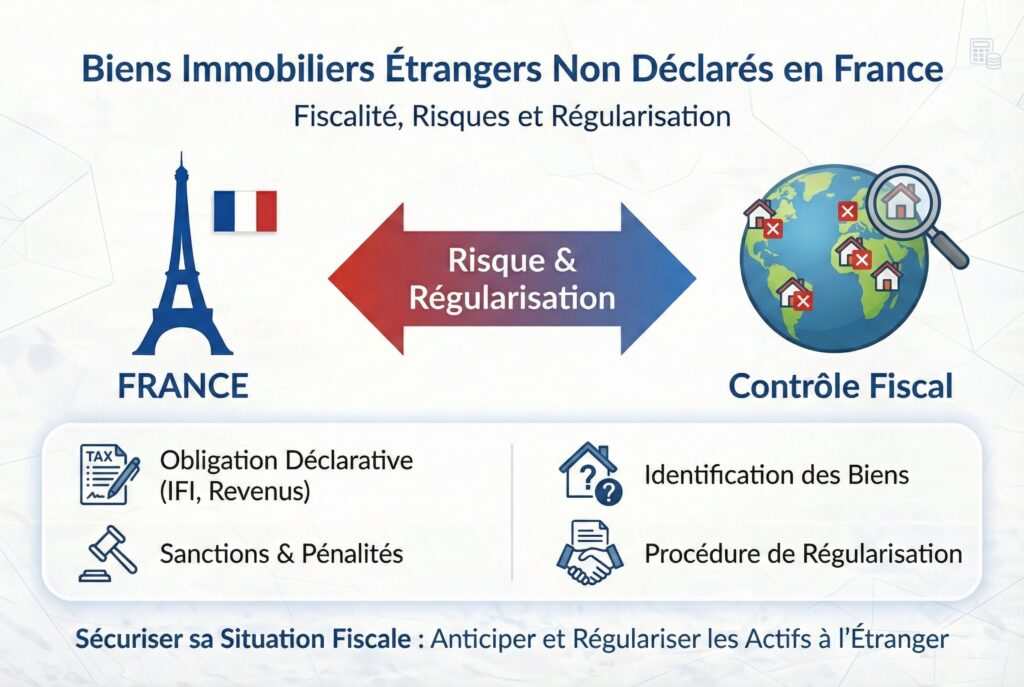
For a long time, the holding of real estate abroad by French tax residents was a blind spot in international tax cooperation. Unlike bank accounts, real estate largely fell outside automatic exchange mechanisms, making audits more difficult and detection more random.
This situation is changing rapidly. France and several states have signed a joint declaration aimed at implementing an automatic exchange of information on real estate, in order to strengthen tax transparency for these non-financial assets.
A major turning point: the automatic exchange of information on real estate
The stated objective is to close a long-standing gap: enabling tax authorities to exchange, in a structured and regular manner, information already available on real estate held by non-residents.
In practical terms, this strengthens the French tax authority’s ability to:
- identify undeclared foreign real estate;
- cross-check information against French tax returns;
- detect inconsistencies regarding ownership, rental income, disposals, or the source of funds.
Which countries are concerned?
The signatory states include in particular: South Africa, Germany, Belgium, Brazil, Chile, Korea, Costa Rica, Spain, Finland, Greece, Iceland, Ireland, Italy, Lithuania, Malta, New Zealand, Norway, Peru, Portugal, Romania, United Kingdom, Slovenia, Sweden and Gibraltar.
Si vous détenez un bien immobilier dans l’un de ces pays et que vous êtes résident fiscal en France, il devient essentiel d’évaluer votre niveau de conformité fiscale et, si nécessaire, d’envisager une régularisation.
What information can be exchanged?
Under the announced framework, the exchange concerns information useful for tax audits, which may include:
- the identification of the property and its location;
- the identity of the owner or beneficial owner;
- the acquisition date and, where applicable, the disposal date;
- value and transaction details;
- income derived from the property, in particular rental income;
- gains realised on disposal, in particular real estate capital gains.
This data is intended to be cross-checked against reporting obligations in France, which significantly increases the likelihood of detection in the event of an omission.
What obligations in France for real estate held abroad?
The tax obligations of a French resident who owns real estate abroad depend in particular on:
- the nature of the property and how it is held (direct ownership or via a company);
- the income generated (letting, making it available, etc.);
- whether there has been a disposal or a transfer;
- the tax treaties between France and the state where the property is located.
Depending on the circumstances, voluntary disclosures may concern non-time-barred years in relation to:
- income tax (for example, undeclared rental income);
- wealth tax, in particular real estate wealth tax when thresholds are exceeded;
- gift tax or inheritance tax in the event of a transfer;
- and, depending on the case, overall wealth consistency and substantiation of the source of funds.
Why regularise before an audit?
With the extension of tax transparency to real estate, taxpayers exposed to reporting omissions must take one key point into account: the more information circulates automatically, the greater the risk of an audit.
A spontaneous voluntary disclosure often makes it possible to:
- secure your tax position on a lasting basis;
- reduce the risk of significant penalties;
- properly reconstruct your tax history (income, ownership, disposals, transfers);
- plan an estate transfer without weakening heirs’ position.
Our support
Voluntary disclosure of undeclared foreign real estate is not limited to “filing forms”. It requires a technical analysis of the obligations, the applicable tax treaties, the income history, and the ownership structure.
Our experience with voluntary disclosures enables us to support our clients effectively in:
- analysing tax obligations in France;
- preparing the necessary returns for non-time-barred years;
- structuring a consistent and secure file;
- managing the procedures and exchanges related to these complex matters.
Frequently asked questions
Must real estate abroad be declared in France?
If you are a French tax resident, you may have reporting obligations in France (income, real estate wealth tax, filings related to a transfer), even if the property is located abroad. The analysis depends on the tax treaties and your situation.
Is foreign rental income taxable in France?
It may be taxable in France or taken into account depending on territoriality rules and the applicable tax treaty. It is essential to verify the correct treatment in order to avoid omissions and inconsistencies.
What should you do if the property has never been declared?
It is recommended to assess the situation promptly for non-time-barred years and determine an appropriate voluntary disclosure strategy, before any request for information or audit by the tax authorities.
Conclusion
The automatic exchange of information on real estate represents a paradigm shift. Undeclared foreign real estate becomes easier to detect, and the taxpayers concerned must act methodically.
Anticipation and, where necessary, voluntary disclosure are the best ways to secure your tax and wealth position, while reducing the risk of reassessment and penalties.